
European Sentry Alternatives

If you search for a European alternative to Sentry, you quickly find a mix of tools that are not directly comparable.
Some are Sentry-compatible error trackers, others are broader monitoring platforms that include error tracking, and some focus primarily on logs or framework-specific debugging workflows. The category “Sentry alternative” therefore covers several different kinds of systems.
The most useful first distinction is the kind of product. Some tools center the debugging workflow around the exception itself: stacktrace, code context, local variables, and request metadata. Others treat errors as one signal among many next to traces, metrics, logs, and uptime data.
This difference determines the migration effort. In the Sentry-compatible camp migration can be as small as a DSN change. In the APM camp you typically adopt a new agent, a different data model, and a different way of navigating failures.
“European” then adds a second layer. It can mean EU-hosted data, an EU vendor, or software you run on your own infrastructure inside the EU. Those constraints overlap, but they are not the same thing.
If your main question is the narrower compliance angle rather than the broader tooling landscape, see the GDPR-compliant alternative to Sentry.
Hosted & Sentry-compatible
Bugsink
Bugsink is the most direct match if the goal is “something like Sentry, but hosted in Europe, without switching away from the Sentry SDK ecosystem.” It is an error tracker, not an APM product: the exception is the center of the workflow, and the UI is built around understanding what broke and why.
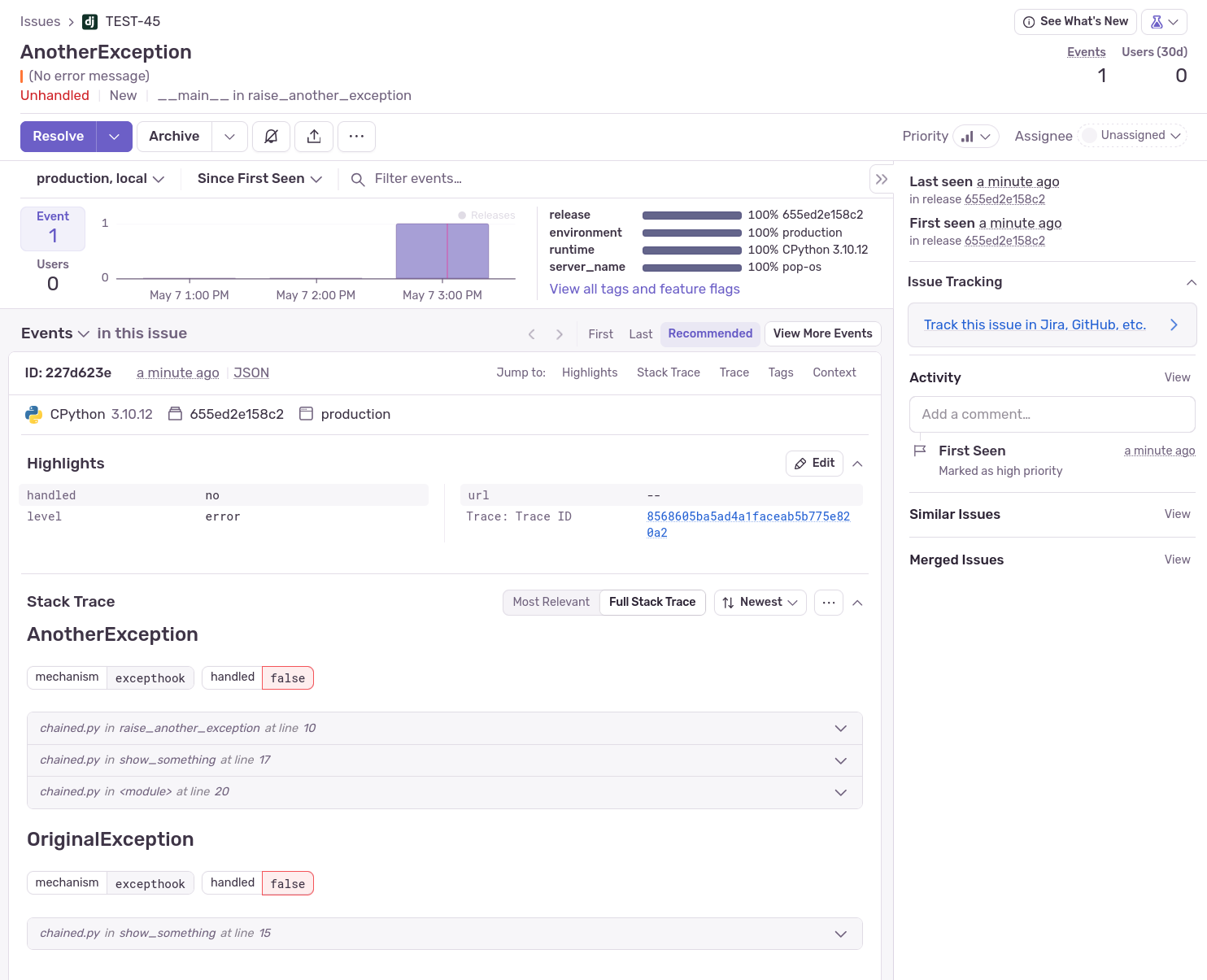
That matters because the migration story stays small. Applications already using Sentry SDKs can keep those SDKs and point them at a different backend. The debugging model also stays familiar: grouped issues, stacktraces, source snippets, and local variables, rather than a general observability dashboard.
On language support, Bugsink inherits the breadth of the Sentry SDK ecosystem rather than maintaining its own smaller set of proprietary agents. That means coverage across backend languages, browsers, mobile, and frameworks without having to maintain a parallel client ecosystem. More detail about the approach is described in Errors First.
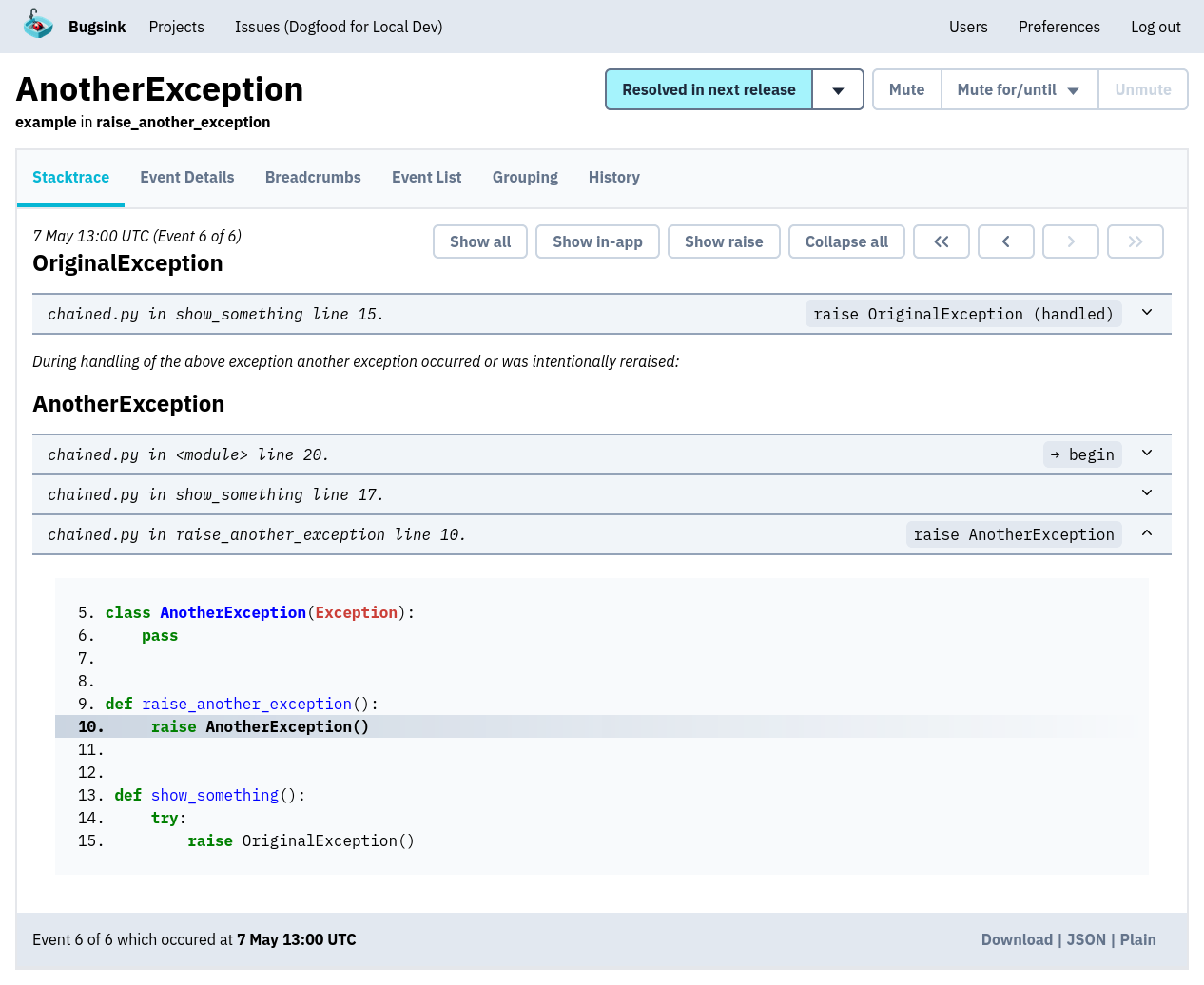
Hosted pricing is the lightest part of the story, but it still matters. The public hosted tiers start at 15K/month free, then 75K for $16/month, 600K for $50, 3M for $158, with higher-volume tiers at 15M for $568 and 50M for $1,288. Enterprise hosting starts at €500/month, depending on region, event volume, and support level.
Better Stack
Better Stack Errors is also in the “keep the Sentry SDKs” bucket, but the product shape is different. Better Stack offers Sentry-compatible error tracking inside a larger operations platform that includes uptime monitoring, logging, incident management, and the rest of their observability tooling.
That can be attractive if the requirement is not just “replace Sentry” but “standardize on one operations platform.” It is less attractive if the requirement is specifically “keep error tracking simple.” The workflow is therefore not just “open issue, read stacktrace, fix bug,” but “errors as one object inside a larger operational system.”
Language coverage is broad because Better Stack’s error ingestion works with existing Sentry SDKs. That puts it in the same migration shape as Bugsink, but not in the same product category. One is a dedicated error tracker; the other is an observability suite that happens to include a Sentry-compatible entry point.
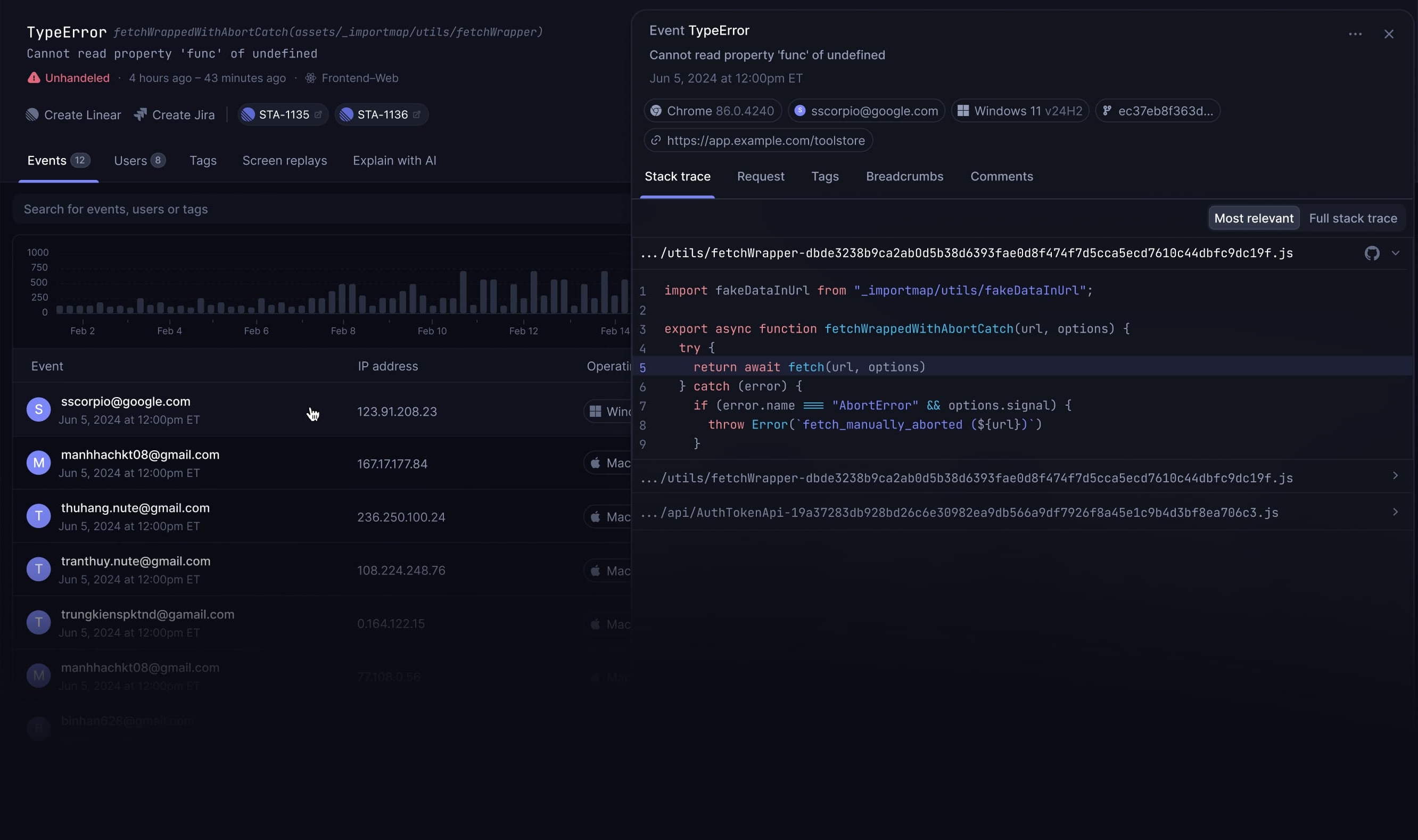
Pricing is usage-based. Their pricing page lists 100,000 exceptions included, $0.000075 per additional exception, and 90 days retention on the included tier.
EU-hosted APM platforms
AppSignal
AppSignal comes from a different direction. It is an APM product: request traces, performance measurements, host monitoring, dashboards, logging, uptime checks, and error tracking in one system. Their official pricing and docs pages list support for Ruby on Rails, Elixir, Node.js, JavaScript error tracking, Python, Go, Java, PHP, and Rust, along with integrations such as OpenTelemetry, Vercel, and Kubernetes.
Even when AppSignal shows an exception, it is usually framed inside a broader performance narrative. You are not just looking at “what exception happened,” but also at the request, timing, surrounding traces, and host behavior. That is useful when you want APM. It is a different workflow from a dedicated error tracker that treats the exception itself as the highest-signal event.
The company story also changed in 2025. AppSignal announced a $22 million Series A led by Austin-based Elsewhere Partners, appointed a new CEO, and established U.S. operations while keeping its European presence. Its privacy policy still says application data sent to the service is stored in certified facilities in the Netherlands, while also noting that some third parties may be outside the EEA.
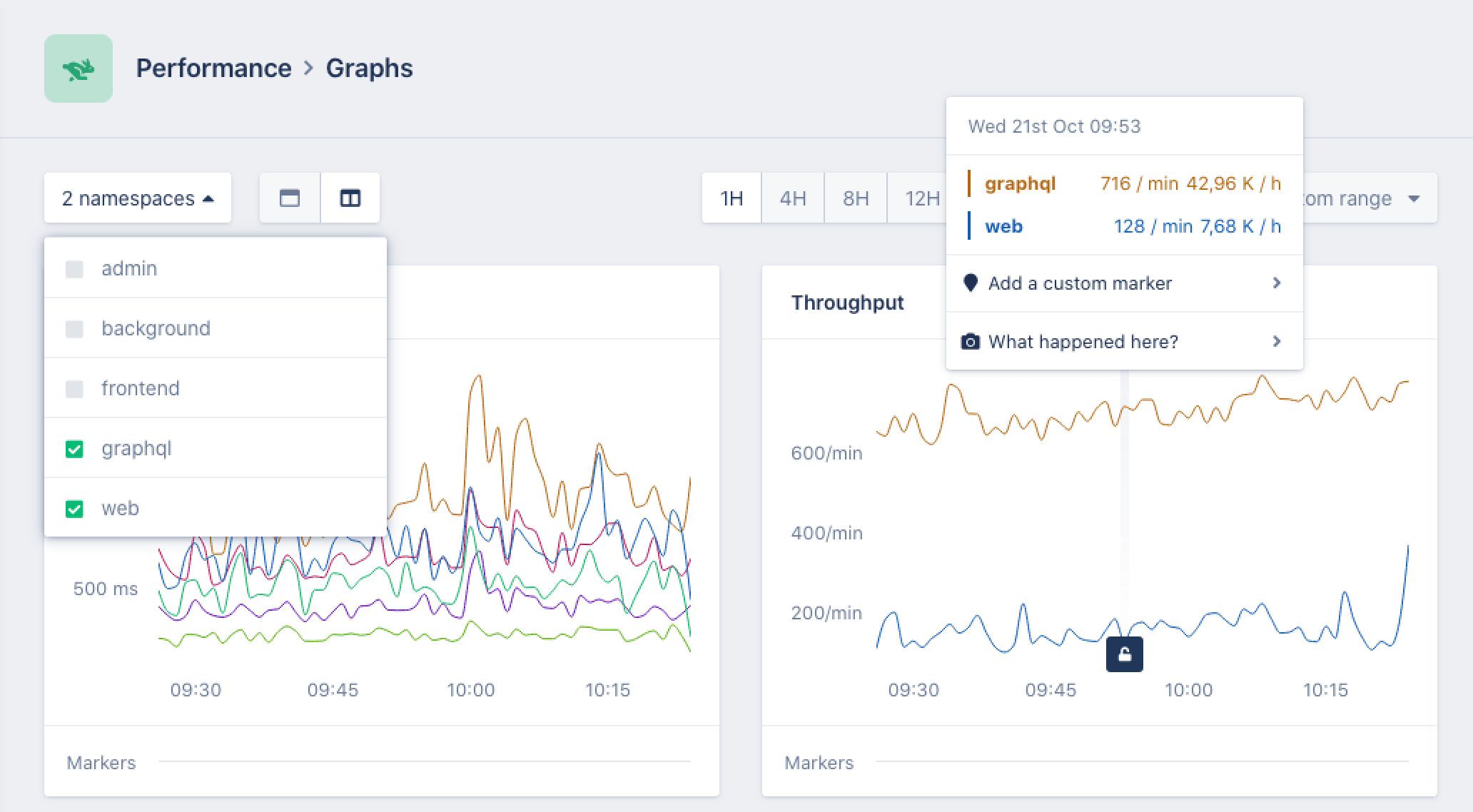
Pricing is request-based rather than exception-based. The current pricing page shows a free plan with 50K requests, 1GB logging, and 5-day retention, and paid plans starting at €219/year (about €18.25/month) for 250K requests/month.
Bugfender
Bugfender is different again. It is best thought of as remote logging plus crash reporting, especially for mobile, frontend, and device-heavy environments. It collects log streams from devices and synchronizes them with the server, which makes it possible to inspect what happened on a device even when it was offline.
That changes the depth of information you get. With a Sentry-style tracker the center of gravity is the exception: stacktrace, code location, local variables, event context. With Bugfender the center is often the log timeline that led up to the crash. That can be exactly what you want for mobile support and field debugging.
The service is typically used as hosted SaaS, but it also offers an on-premises edition. The company behind it is Beenario GmbH in Germany with operations in Barcelona.
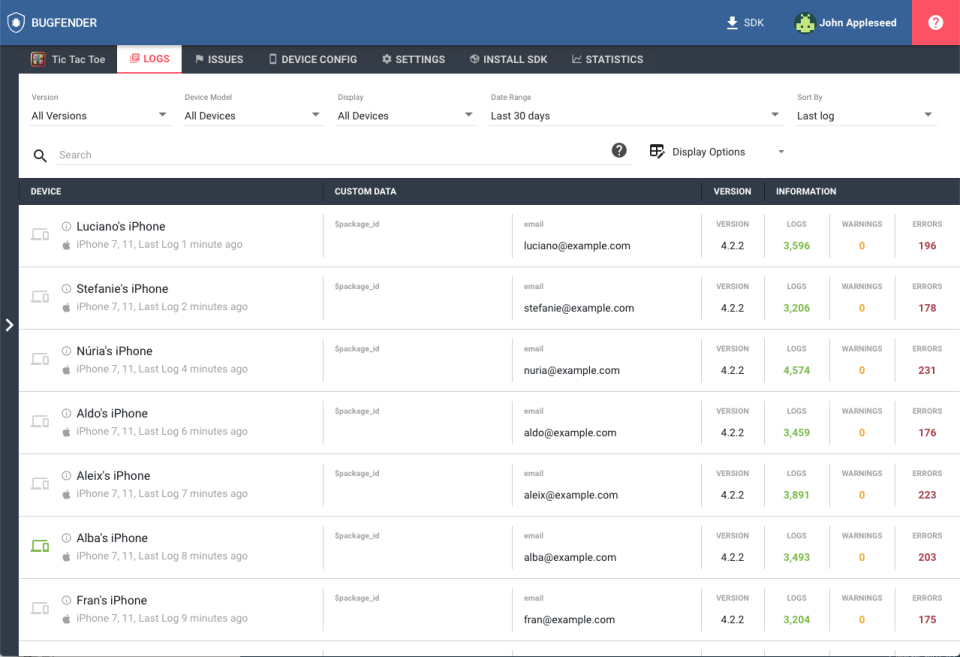
Pricing follows the logging model. The public page shows Free at 100K daily log lines with 24h retention, Team at €39/month for 10M monthly log lines with 7-day retention, Pro at €89/month with 30-day retention, and an on-premises plan starting at €3,000/month.
Flare
Flare is the narrowest product in this list, and that is deliberate. It is built specifically for Laravel, and is developed by the Belgian company Spatie. If your stack is Laravel that focus can be a strength, because framework-specific tooling can expose details that a generic cross-language tracker cannot.
That specialization also changes the “depth of information” question. Flare does not try to be a universal backend for every language and framework. Instead it goes deep on one ecosystem and shapes the debugging workflow around that framework’s conventions.
Because it is framework-specific, language support is intentionally narrow. It is the right tool when your production systems are Laravel applications and the wrong tool when they are not.
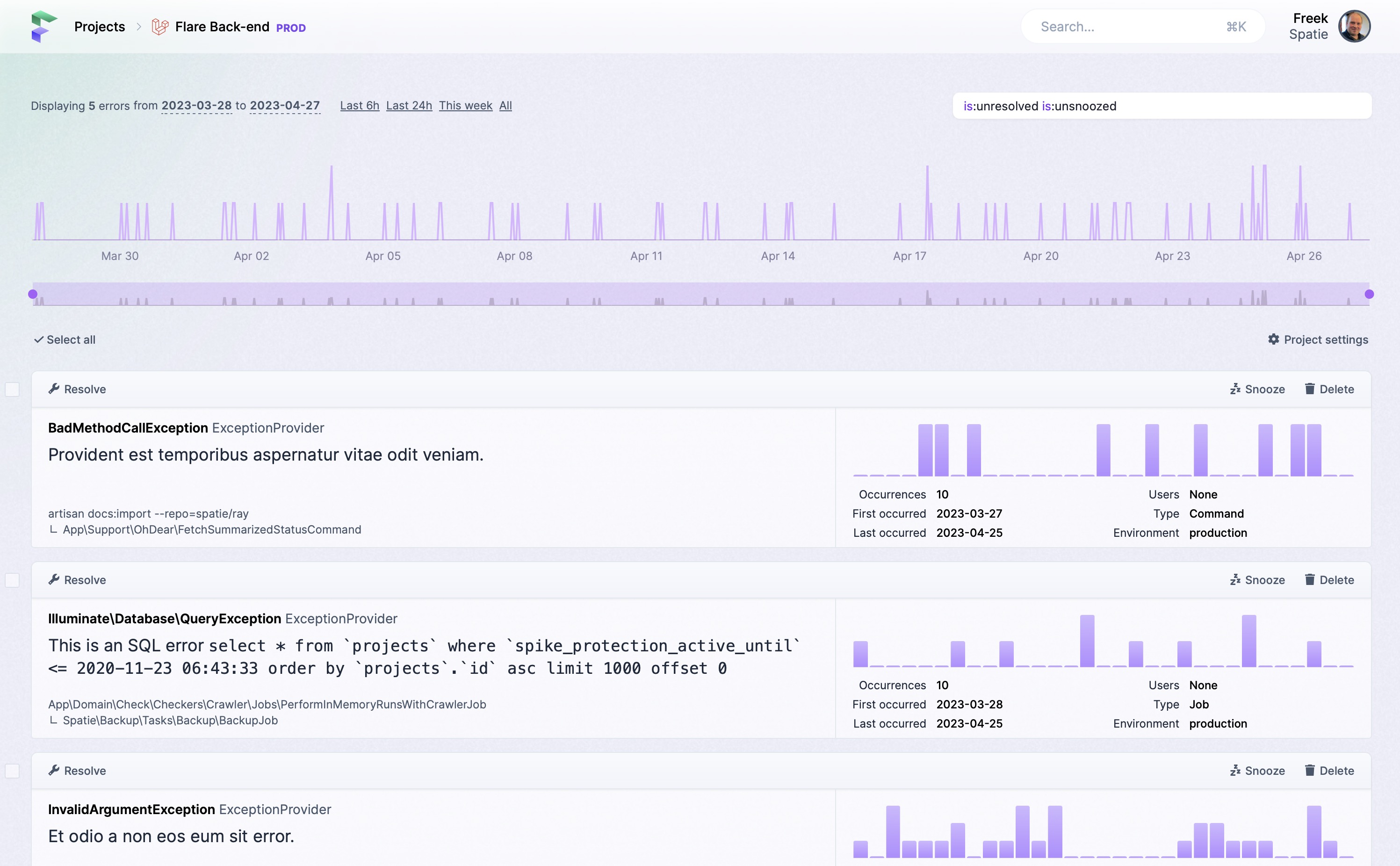
Pricing starts around €29/month for 100,000 error occurrences with 14-day retention.
Self-hosted options
If the real requirement is “keep the data on infrastructure we control,” the comparison changes. Vendor nationality still matters for contracts and procurement, but the central questions become: how much infrastructure does this require, how hard is it to run, and what debugging information does it produce once it runs.
Bugsink
Bugsink was built for this use case. The self-hosted version uses the same Sentry-compatible event model as the hosted one, but the operational footprint is deliberately small: SQLite by default, optional MySQL/PostgreSQL, and a single application rather than a distributed ingestion stack.
On throughput, the reference point is about 18 events/sec on 2 vCPU / 4GB RAM, or roughly 1.5 million events/day. Details about the architecture are described in Built to Self-Host.
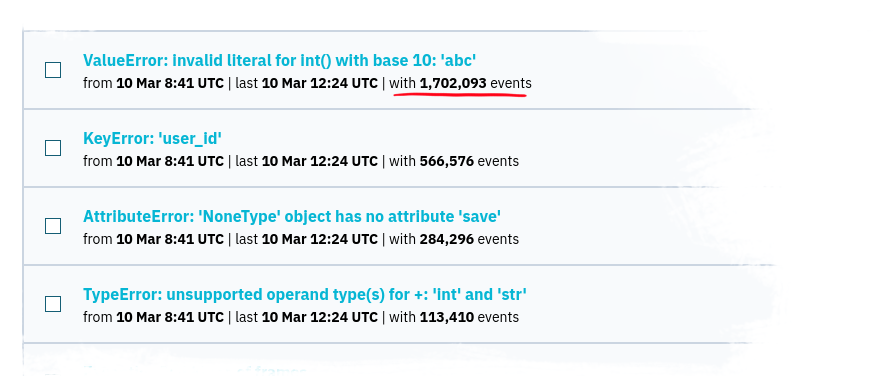
That tells you what “self-hosting” means in practice here: running an error tracker as a normal application rather than running a small telemetry pipeline. On the debugging side the focus stays the same: grouped issues, stacktraces, source lines, local variables, request context, and the shortest path from production failure to understanding.
GlitchTip
GlitchTip is also Sentry-compatible and self-hostable, but its shape is heavier. It was created shortly after Sentry moved away from open source and aims to preserve a Sentry-like system under a permissive license.
Typical deployments include PostgreSQL, Redis, Celery workers, and separate frontend/backend components. Installation usually happens via Docker Compose or Kubernetes.
That is still much lighter than running Sentry itself, but it is not in the same operational category as a single-app deployment.
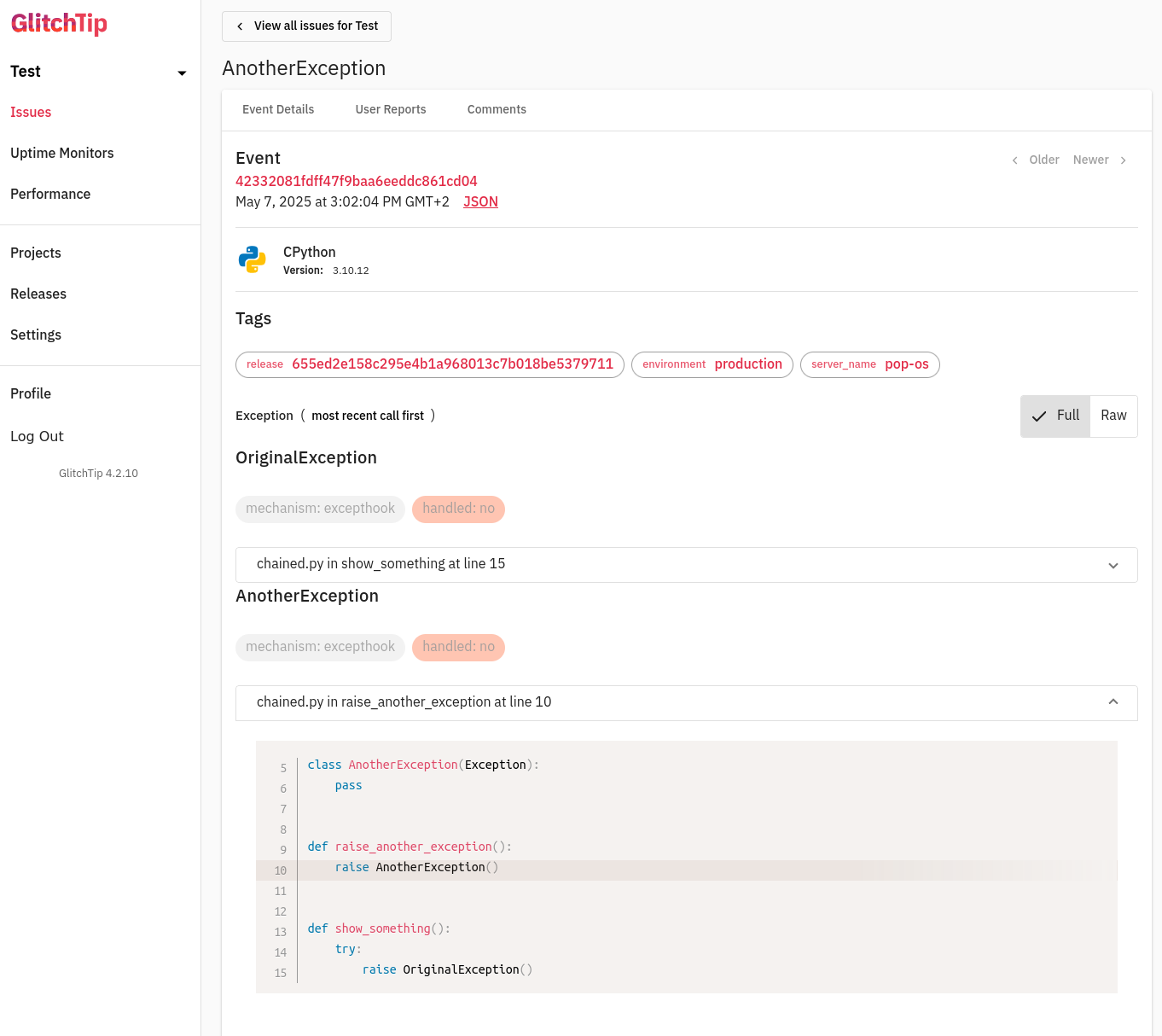
GlitchTip also offers hosted pricing with examples such as $15/month for 100K events, $50/month for 500K, and $250/month for 3M events.
Self-hosted Sentry remains the reference point. It gives you the original product but also the original infrastructure burden. The official self-hosted documentation lists baseline resources of roughly:
- 4 CPU cores
- 16 GB RAM + 16 GB swap
- 20 GB free disk
The system includes PostgreSQL, Kafka, Redis, ClickHouse, Memcached, and several application services.
In practice that means operating a distributed ingestion pipeline rather than a single application. That operational footprint is the reason many searches for “Sentry alternatives” exist in the first place.
Where Sentry’s EU region fits
Another option is not to switch tools at all but to use Sentry’s EU data region.
Sentry introduced EU data residency in November 2023, allowing event data to be stored and processed in the EU.
That addresses one specific requirement: EU event storage. It does not answer every “European” question because Sentry itself remains a U.S. company. Their EU region FAQ notes that they do not contract through an EU legal entity, and some metadata categories remain stored in U.S. systems.
Examples include user accounts, notification settings, integration metadata, access tokens, and audit logs.
For organizations whose requirement is strictly EU event storage, the EU region may be sufficient. For organizations requiring EU vendor jurisdiction or the ability to self-host, it usually is not.
Conclusion
The “European Sentry alternative” question is not just about finding a different product. It is about understanding what kind of product you need, what kind of migration you are willing to do, and what kind of infrastructure you are willing to run. The “European” part adds another layer of requirements that can overlap but are not the same: EU-hosted data, an EU vendor, or self-hosting control.
Bugsink is the closest match if the requirement is “keep the Sentry SDK ecosystem but host in Europe.” It is an error tracker rather than an APM product, and it is built to be self-hosted with a small operational footprint.
If you want a broader operations platform that includes Sentry-compatible error tracking, Better Stack is an option. If you want an APM product with EU-hosted data, AppSignal is a candidate. If you want remote logging and crash reporting for mobile and frontend, Bugfender is worth considering. If you want Laravel-specific diagnostics, Flare is a good fit.